I wasn’t quite sure what to expect coming into this First Year Interest Group. I knew that I loved food and I loved to cook, and that it went pretty well with my major, which at the time was pre-dietetics. Coming out, I have learned so much about things that I didn’t particularly have interest in learning about until I took the classes in this FIG. I am so much more conscious of myself as a consumer and I am more aware of how the farms I see when I leave Madison are related to a much larger system. I learned more about myself and that through cooking and eating, I realized that dietetics is not the career path for me. I am more interested in the art of food rather than the science of food. Laurie Beth sort of indirectly inspired me in a way to become an art major. I came to the conclusion that I wanted to be an advocate for people of color and other underprivileged group in America and one of the best ways to do that was to become a teacher. Particularly, an art teacher.
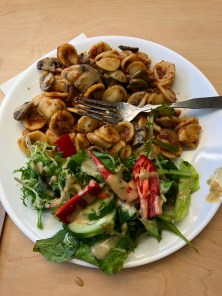 As for the Monday classes, I enjoyed the meals that we made at the beginning of the semester more than the ones at the end of the semester, with the exception of the last class. I loved having the freedom to make my own pasta dish and salad dressing on a whim the first day we cooked without the guidance of a recipe. I was able to just cook something that tasted good. I also really enjoyed the pesto pasta dish because we were able to make it in a similar fashion to the first pasta dish. I really really liked the improvisation aspect because that’s how I cook at home. It was pretty cool when each group made a different dish to serve to the class in a buffet, but I did miss some of those opportunities to improvise where each group cooked for themselves towards the end.
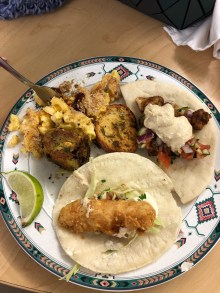 Some of my other favorite dishes we made were the fried catfish with greens, and black eyed peas and rice because it reminded me of the holidays with my family, the huevos rancheros with the rice pudding (I experimented a little bit by adding some salt and that’s exactly what it needed), that spaghetti dish from when Grazia was our guest cook, the glaze that we put on the squash when Chele was our guest cook, and of course the last class meeting where everyone chose their dishes.
Some dishes I didn’t like so much were the Slavic dishes because they felt very heavy in my stomach and I really needed something to balance that out like a salad, the okonomiyaki, which was a little too weird for me, the bacon brown butter pasta because the pasta was under cooked and the radicchio was too bitter and overpowering for my taste, and the quiche because we did not have enough time to execute it well, and it was a bit under cooked as well.
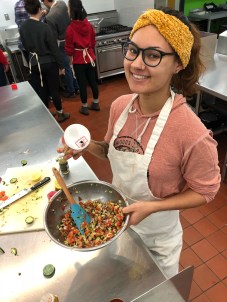
The one thing that I’ve become known for in the class is my love of salt and unfortunately, I was missing a lot of it this semester, especially during the Slow Food lunches. I think that I am going cook for myself from now on haha.
While I did just spend the last two paragraphs complaining because I’m a food snob, I undoubtedly learned something with every new cooking experience we had. I’d never made my own pie crust before, or made fresh pasta, or knew what Slavic people ate or really what their culture was like at all. I’m very grateful for all the guests that we had this semester and I really did learn a lot.
 I also want to thank the other guests we had on Wednesdays and for Slow Food for providing a fresh and unique meal for us every week. I have to say that Lindsay Christens was my favorite guest because I was so engaged with her speaking the entire time. While other guests were still interesting, they did not hold my attention as much. I also really enjoyed the guest, that I unfortunately can’t find the name of, who gave a presentation on Fermentation Fest. I thought that the artwork was incredible and I am interested doing the tour sometime in the coming years if they can keep it going.
As far as the readings go, my favorite reading would still have to be the first article that I read with Grace about the food culture of Mexican Americans and the way that gender roles intertwine with that food culture.
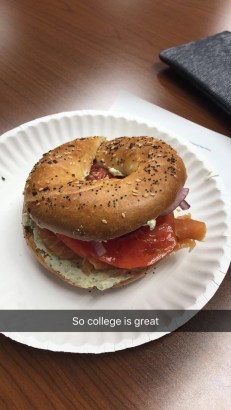
Lastly, another thing that I loved about this class was the bagels and the chicken sandwiches that Laurie Beth brought in during our first couple meetings. They were both AMAZING and I felt like such an adult when I ate them.
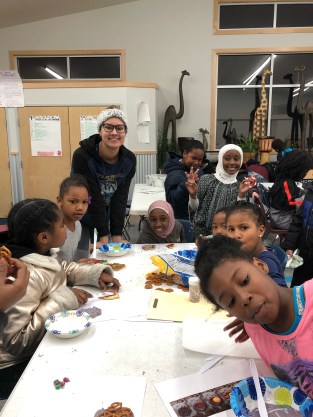 We met the kids in a large classroom area. The vast majority of them were black or Hispanic students. Everything started moving so fast that I never got to introduce myself or learn any of the kids’ names. The plan was to help the kids make their own homemade royal icing to put on pre-made holiday shaped sugar cookies. We separated the kids into three different table groups. The picture to the left is of the kids at my table and myself. Each student was able to help in the process of making the frosting by measuring all the ingredients, adding them to the bowl, and mixing them together. The kids were very polite to each other and let everyone have a turn to help make the frosting. It took about 20 minutes for the frosting to be ready (it only took 5 minutes when I made more myself later) and took up quite a bit of our time with the kids, but it was okay because they kids seemed very excited about their frosting accomplishments. However, I tasted it. It was awful. I’ve come to the conclusion that children will just eat anything that has sugar in it.
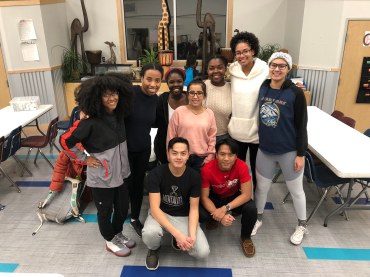 Now that the frosting was done, we gave each kid their own bowl and let them pick what color they wanted their frosting to be. By this point, I was covered in powdered sugar and meringue powder. They decorated their cookies with some very obscurely colored frosting, vanilla wafers, pretzels, sprinkles, and M&Ms. Unfortunately, I didn’t get a picture of any of the cookies. Alas, the parents began to arrive which allowed us to clean the frosting, sprinkles, and glitter from the pine cone ornament making station (children and glitter do not go together. I keep finding glitter in my clothes days later). We took a group picture and said our goodbyes and headed back to campus.
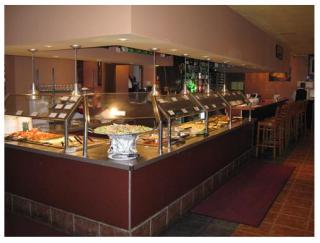 On November 14th, we met at Maharani Indian Restaurant on West Washington. The restaurant was only a short bus ride from campus and they opened early in order to seat us. While we waited for the restaurant to finish opening up the buffet, I decided to treat myself to a mango lassi, a type of Indian yogurt drink, which was quite tasty. Since Laurie Beth was called on urgent passport business, Theron facilitated the class discussion.
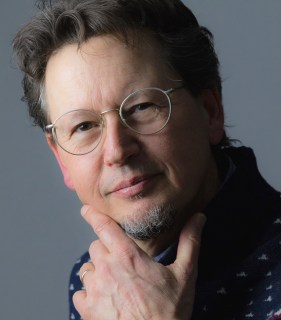 The most obvious form of cross over between Agroecology and Food Studies is when Professor Mike Bell came in as a guest for us during one of our Wednesday class meetings. Seeing him in a new setting came as a surprise to myself and many of my classmates as we are used to seeing him as one of the professors for the Agroecology class. I actually found it funny for some reason. He was exactly the same as he is in Agroecology with his very philosophical outlook on life.
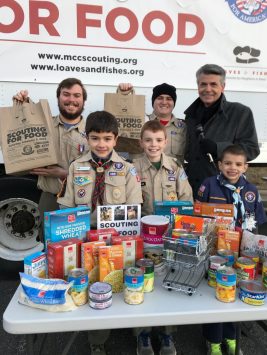 This past week, Libby and I read the article, titled “Want Amid Plenty: From Hunger to Inequality” published by Janet Poppendieck in 2000. It was mostly about how there is so much food produced in America. So much so, that a lot of it is never eaten and goes to waste. In fact, the USDA estimates that more than a quarter of our food goes to waste between production and cooking. There is also lots of talk about how the issues of obesity and over-eating in America. However, at the same time that this is happening, there is another issue that often goes unspoken about, and that is that millions of Americans are struggling with food insecurity. When people think of hunger, the first thing they probably think of is a starving child in another country so there is a lot of disconnect between the needy in America and those that are more well-off. There are actually several programs in the US that are there to help reduce some of this disparity. One of these that they author kept coming back to was the Boy Scouts Food Drives.
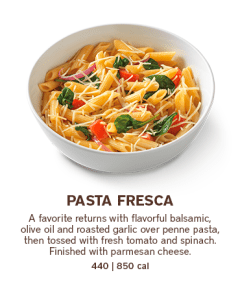 Dinner-
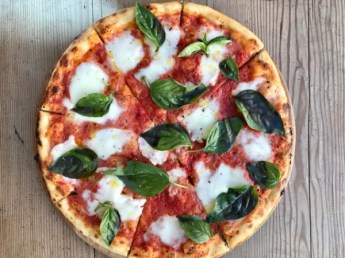 The author starts out by discussing how pizza is a very globalized food with many different cultures having their own take on pizza. From deep dish, to thin crust, to a calzone. However, the American pizza restaurants have “glocalized” pizza and turned the standard pizza into “a large sliced pizza, heavily garnished, baked in pans, and the taste is homogeneous, so a Domino’s pepperoni pizza ordered in Chicago should taste the same as one ordered in London or in Paris” (Ceccarini 438). But these are not the types of pizza the author is talking about in this article. While chain-restaurant pizzas are still very present in Japan, Ceccarini mainly focuses on authentic Italian pizza and their masters, the pizzaioli.
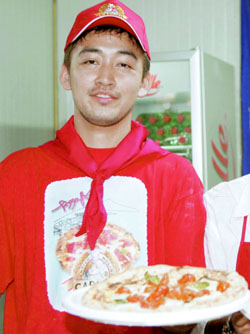 Though originally pizza started out as a poor person’s food in Italy, it has become popular throughout the world. Pizza in Japan really started to take off between the ’50s and ’60s and only increased in popularity from there throughout the ’70s and ’80s. Antonio Cancemi was on of the first people to open an authentic Italian restaurant in 1957 and his restaurant, Antonio’s, is still one of the oldest family owned restaurants in Japan. Making pizza has become recognized as an art form in Japan similarly as it has in Italy. There is a lot of cross over between Japan and Italy with many Italian people coming to Japan to open pizzerias, and many Japanese people to coming to Italy to learn how to become a pizzaiolo and then taking their skills back to Japan. Japanese people are very common to see in the pizza scene. Makoto Onishi (pictured above), a Japanese pizzaiolo, has one the Pizza Fest Competition in Naples, Italy, twice.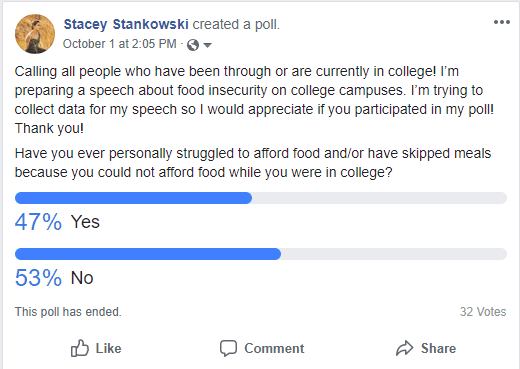
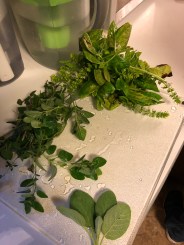

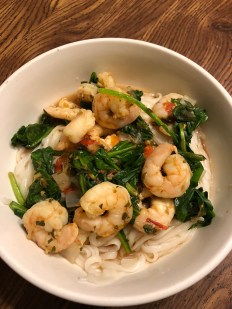
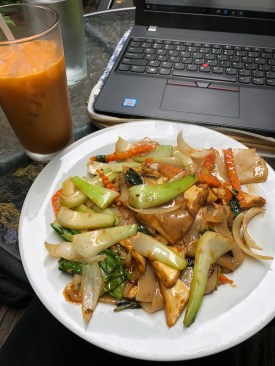 Today, Friday, September 21, 2018, I visited Rising Sons Deli, a Thai food restaurant on State Street. I was feeling pretty down in the dumps today. So, I figured the best way to self-medicate would be to get some of my favorite cuisine and write a restaurant review. I was a little confused when I first walked in because there wasn’t a hostess so I kind of wandered awkwardly around the bar until a man asked me if I wanted to eat for here or to go. The atmosphere was nice and there weren’t very many people. I don’t think there was any music playing which is uncommon for a restaurant. Maybe that’s why I felt so awkward. It smelled fantastic though. I did notice that a lot of tables had dishes on them still, though they weren’t that busy, however, I know how this goes in my experience. They seemed to be short staffed.
 Stace's Food Blog