Reflection of the Semester

I wasn’t quite sure what to expect coming into this First Year Interest Group. I knew that I loved food and I loved to cook, and that it went pretty well with my major, which at the time was pre-dietetics. Coming out, I have learned so much about things that I didn’t particularly have interest in learning about until I took the classes in this FIG. I am so much more conscious of myself as a consumer and I am more aware of how the farms I see when I leave Madison are related to a much larger system. I learned more about myself and that through cooking and eating, I realized that dietetics is not the career path for me. I am more interested in the art of food rather than the science of food. Laurie Beth sort of indirectly inspired me in a way to become an art major. I came to the conclusion that I wanted to be an advocate for people of color and other underprivileged group in America and one of the best ways to do that was to become a teacher. Particularly, an art teacher.
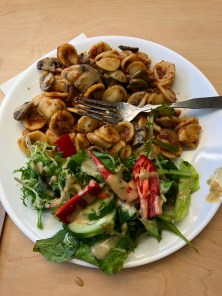
Image-22As for the Monday classes, I enjoyed the meals that we made at the beginning of the semester more than the ones at the end of the semester, with the exception of the last class. I loved having the freedom to make my own pasta dish and salad dressing on a whim the first day we cooked without the guidance of a recipe. I was able to just cook something that tasted good. I also really enjoyed the pesto pasta dish because we were able to make it in a similar fashion to the first pasta dish. I really really liked the improvisation aspect because that’s how I cook at home. It was pretty cool when each group made a different dish to serve to the class in a buffet, but I did miss some of those opportunities to improvise where each group cooked for themselves towards the end.
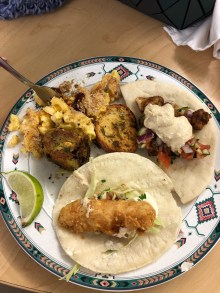
Image-14Some of my other favorite dishes we made were the fried catfish with greens, and black eyed peas and rice because it reminded me of the holidays with my family, the huevos rancheros with the rice pudding (I experimented a little bit by adding some salt and that’s exactly what it needed), that spaghetti dish from when Grazia was our guest cook, the glaze that we put on the squash when Chele was our guest cook, and of course the last class meeting where everyone chose their dishes.

Some dishes I didn’t like so much were the Slavic dishes because they felt very heavy in my stomach and I really needed something to balance that out like a salad, the okonomiyaki, which was a little too weird for me, the bacon brown butter pasta because the pasta was under cooked and the radicchio was too bitter and overpowering for my taste, and the quiche because we did not have enough time to execute it well, and it was a bit under cooked as well.
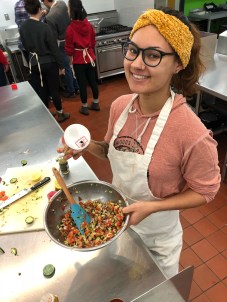
Image-13

The one thing that I’ve become known for in the class is my love of salt and unfortunately, I was missing a lot of it this semester, especially during the Slow Food lunches. I think that I am going cook for myself from now on haha.

While I did just spend the last two paragraphs complaining because I’m a food snob, I undoubtedly learned something with every new cooking experience we had. I’d never made my own pie crust before, or made fresh pasta, or knew what Slavic people ate or really what their culture was like at all. I’m very grateful for all the guests that we had this semester and I really did learn a lot.
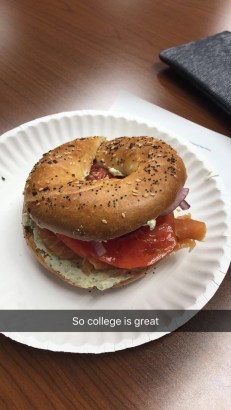
Image-21I also want to thank the other guests we had on Wednesdays and for Slow Food for providing a fresh and unique meal for us every week. I have to say that Lindsay Christens was my favorite guest because I was so engaged with her speaking the entire time. While other guests were still interesting, they did not hold my attention as much. I also really enjoyed the guest, that I unfortunately can’t find the name of, who gave a presentation on Fermentation Fest. I thought that the artwork was incredible and I am interested doing the tour sometime in the coming years if they can keep it going.

As far as the readings go, my favorite reading would still have to be the first article that I read with Grace about the food culture of Mexican Americans and the way that gender roles intertwine with that food culture.

Lastly, another thing that I loved about this class was the bagels and the chicken sandwiches that Laurie Beth brought in during our first couple meetings. They were both AMAZING and I felt like such an adult when I ate them.
Lagniappe Opportunity: Vera Court

I am part of the student advisory board for my scholarship program, the PEOPLE Program. It was through this that I learned about a volunteer opportunity that we were planning on doing at the Vera Court Community Center on the North Side of Madison, where there are a lot of people of color as well as other underprivileged groups. During one of our meetings, we discussed what we could do with the kids that go to the community center for their after school program. The students were elementary school aged so we needed to plan an activity that would be appropriate and engaging for the kids. In the spirit of the holiday season, we chose to do holiday cooking decorating. This was absolutely perfect for me since I still needed to complete a lagniappe opportunity blog post. I’m not the biggest fan of kids, but the opportunity was too perfect to pass up. So alas, I mentally prepared myself to entertain a group of thirty 7-year-olds that were hyped up on sugar. We loaded up our vans and drove to the North Side. Despite being from Madison, I’d never been in the Vera Court Neighborhood before.

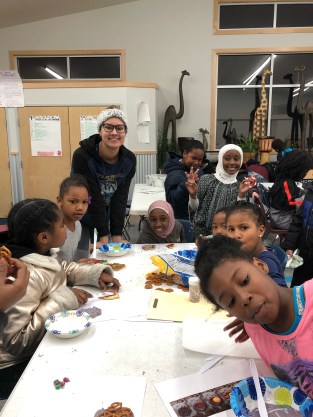
Image-11We met the kids in a large classroom area. The vast majority of them were black or Hispanic students. Everything started moving so fast that I never got to introduce myself or learn any of the kids’ names. The plan was to help the kids make their own homemade royal icing to put on pre-made holiday shaped sugar cookies. We separated the kids into three different table groups. The picture to the left is of the kids at my table and myself. Each student was able to help in the process of making the frosting by measuring all the ingredients, adding them to the bowl, and mixing them together. The kids were very polite to each other and let everyone have a turn to help make the frosting. It took about 20 minutes for the frosting to be ready (it only took 5 minutes when I made more myself later) and took up quite a bit of our time with the kids, but it was okay because they kids seemed very excited about their frosting accomplishments. However, I tasted it. It was awful. I’ve come to the conclusion that children will just eat anything that has sugar in it.
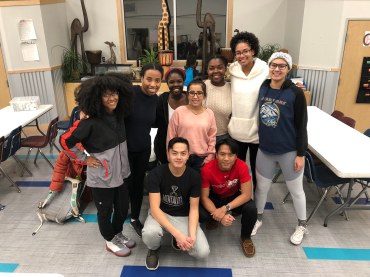
Image-12Now that the frosting was done, we gave each kid their own bowl and let them pick what color they wanted their frosting to be. By this point, I was covered in powdered sugar and meringue powder. They decorated their cookies with some very obscurely colored frosting, vanilla wafers, pretzels, sprinkles, and M&Ms. Unfortunately, I didn’t get a picture of any of the cookies. Alas, the parents began to arrive which allowed us to clean the frosting, sprinkles, and glitter from the pine cone ornament making station (children and glitter do not go together. I keep finding glitter in my clothes days later). We took a group picture and said our goodbyes and headed back to campus.
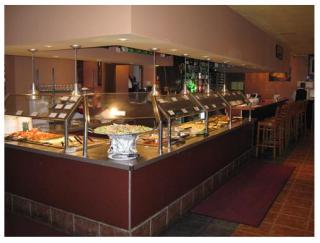
Me being the foodie that I am, I remembered there was a Habenero’s (think Chipotle or Qdoba but way more traditional and amazing) nearby and offhandedly mentioned how fabulous their burritos are. Much to my surprise, my PEOPLE adviser suggested we stop for some Mexican goodness. The two other students in the van and I ordered our tacos and burritos and my adviser offered to pay for all of our meals. So I got a Lagniappe opportunity and a free burrito.

Summary for November 14th

maharani2On November 14th, we met at Maharani Indian Restaurant on West Washington. The restaurant was only a short bus ride from campus and they opened early in order to seat us. While we waited for the restaurant to finish opening up the buffet, I decided to treat myself to a mango lassi, a type of Indian yogurt drink, which was quite tasty. Since Laurie Beth was called on urgent passport business, Theron facilitated the class discussion.

In preparation, one group had read the article about the horrors of the meat packing industry, The Chain Never Stops by Eric Schlosser, and the other group read The Political Economy of Food Aid by Jennifer Clapp. We discussed the questions that were created Erin K. for the Chain Never Stops and the questions for the Political Economy of Food Aid that were written by Grace. I read the Chain Never Stops and the question that stuck out to me that I my group discussed was “What did you find most surprising about this reading?” Rachel said that what she found most surprising was that the money that was given to the families of people who died working on the production line amounted to $70,000. It was interesting that amount is what is considered to be the cost of a human life.

At last, the food was ready, and we loaded up our plates with Indian food. There was a mix of vegetarian and meat dishes that I think accommodated the dietary needs for the people in our class. Unfortunately, almost as soon as I started eating, my appetite just about disappeared, and I didn’t eat a lot which was disappointing because I didn’t get a chance to try everything.

Our wonderful guest this week was Lindsay Christians, who is a food writer for the Capital Times. I really liked her as a guest. I thought she was very funny and was a very engaging speaker. Some of our past guests didn’t quite hold my interest, but Lindsay talked with us rather than talked at us. She started off by talking about her experience as a food writer and what kinds of things she does in her position. She talked about how she does restaurant reviews and other side gigs she has including being a theater critic for the Overture Center’s Jerry Awards. This is when I found out that she had seen the performance of my high school musical that I won a Jerry Award for and was part of the voting process in choosing the winners. She also knows my old choir teacher and director pretty well. It really is a small world and it was super cool to find out that we had that in common.

After telling us about herself, Lindsay then discussed our blogs that she had read. She told us what we did well and what we could improve upon. I found her advise to be particularly helpful. One of the things she said to be aware of in our writing is our implicit biases and it made me think of my restaurant review for Rising Sons Deli where I said the menu reminded me of a cheap Chinese food place without realizing the connotations it could have.

I think this was an excellent way to spend our last Wednesday together as a FIG group in Laurie Beth’s class and a huge thanks to Theron for moderating our class in Laurie Beth’s place.

Linking Up Classes

As we are reaching the end of the semester, I think now is as good a time as any to take look at my classes and see how they are similar. I realized there actually is a lot of cross over between Food Culture FIG classes. Agroecology and Food Studies both center around food, so naturally they have many things in common. There are also some common themes between Anthropology as well.

bell-2016The most obvious form of cross over between Agroecology and Food Studies is when Professor Mike Bell came in as a guest for us during one of our Wednesday class meetings. Seeing him in a new setting came as a surprise to myself and many of my classmates as we are used to seeing him as one of the professors for the Agroecology class. I actually found it funny for some reason. He was exactly the same as he is in Agroecology with his very philosophical outlook on life.
Another thing that was a crossover between Food Studies and Agroecology was the urban agricultural student organization, F.H. King. I don’t remember the name of the guest that came in and talked to our class about F.H. King, but they explained to us what the student organization does on campus, including their Harvest Handouts that happen during the growing season, and how we can get involved. A sort of AHA moment occurred in Agroecology when another student in the class who is a member of F.H. King leadership gave a small presentation about the organization.

One thing I noticed pretty early on is the cross over of ideas in Food Studies and Anthropology, once we learned about it, was the idea of anthropological fieldwork in our textbook. The first article I had to read for class was the one about Mexican-American women and their culture in regard to food and gender roles (another cross over!). This article was written by an anthropologist that went into one of these places where the Hispanic people lived and interviewed them. The author first started out by gaining credibility and told how she went about doing ethical fieldwork. Essentially, this article was a small ethnography about this group of marginalized people.

A cross over between all three classes is the idea of knowing where your food is coming from. In Anthropology, our first fieldwork journal assignment was to look at a piece of food and do research about all the ingredients within that food to figure out where each individual ingredient had come from, who produced it and how they are treated by their employers, how the production of that ingredient affects the environment, etc. A lot of the articles we read in class had to do with putting faces to the food we were eating like the pizziaolis that made traditional pizza in Japan or the undocumented workers in the meat packing industry. Recently, we also had a lecture in Agroecology about identity in agriculture and who are the people that are growing food for the country, the majority of them being straight, white, men.

Pitch for “Want Amid Plenty:”

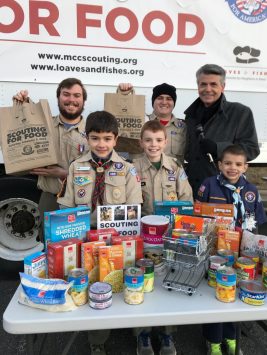
Scout-Group-Shot-with-Larry-e1519230175323This past week, Libby and I read the article, titled “Want Amid Plenty: From Hunger to Inequality” published by Janet Poppendieck in 2000. It was mostly about how there is so much food produced in America. So much so, that a lot of it is never eaten and goes to waste. In fact, the USDA estimates that more than a quarter of our food goes to waste between production and cooking. There is also lots of talk about how the issues of obesity and over-eating in America. However, at the same time that this is happening, there is another issue that often goes unspoken about, and that is that millions of Americans are struggling with food insecurity. When people think of hunger, the first thing they probably think of is a starving child in another country so there is a lot of disconnect between the needy in America and those that are more well-off. There are actually several programs in the US that are there to help reduce some of this disparity. One of these that they author kept coming back to was the Boy Scouts Food Drives.

One of the reasons people focus on solving hunger is because it does really have a simple solution: give people food. It is a social issue that doesn’t have a complicated answer like ending racism or abortion, and it is something that everyone can empathize with. Everyone has felt at least a mild form of hunger in there lifetime whether they skip lunch or forget to eat during an intense study session. It isn’t comfortable and it is caused by a basic need not being met, so people feel as though they have a moral obligation to help feed the hungry. A big motivating motto is that “hunger has a cure.”

Another aspect of helping the hungry is that it is an ongoing issue. While the solution is simple, it is only temporary. One quote that stuck out to me in the article was “People don’t eat in the long run, they eat every day,” made by Harry Hopkins.

This article was surprising political with people who help the hungry being called “progressives” and that feeding the hungry is a social issue that both conservatives and liberals and get behind. It also mentioned that the right wing relies on “token solutions” to hunger, such as walks, bikes, swims, etc. for hunger, as being good enough to solve hunger in the United States so they can slowly undo welfare programs that are designed to help people in need. The author definitely shows their political bias in this article.

Libby and I overall did not recommend the class read this article. I thought that it was not reader-friendly as it used some pretty big words and complicated language. Libby thought it was interesting but did not offer a lot of new, eye-opening information. In general, we thought that there were more interesting articles for the class to read.

Weekend Food Diary

This past weekend I kept a food diary of all things I ate while I was at home and it helped me realize some things about my diet.

For this food diary, I kept track of what I ate on Friday, Saturday, and Sunday. I didn’t count my calories because I was kind of scared to see how much I was actually eating, and I know I’ve had issues with counting calories in the past.Image-10

I was out of the house for most of the weekend working and spending time with my friends and boyfriend, so I didn’t prepare any food like I usually do. To the left is a super cute completely un-edited picture of my boyfriend and I at prom.

I feel fairly guilty thinking about it because I spent a lot of money on food and none of it was all that healthy. One common trend is that I eat two meals a day because I sleep in late. I’m not a morning person whatsoever, so I regularly sleep in until around lunch time and then I only have time to eat two meals during the day. This weekend was not unique in that aspect. I did get up earlier on Friday because I have an 8:50 class, but the earliest I got up this weekend was 10:00 on Saturday (which is early for me) because I had plans with my boyfriend. But without further ado, let’s get into it.

Friday: 

Breakfast-

  • Mixed berry Chobani smooth yogurt

Lunch-

  • Cup of chicken chili with sour cream and cheese (did not finish)
  • Watermelon
  • Grapes
  • Water

Dinner-

  • 6-inch sandwich on whole grain from Subway
    • Salami
    • Pepper jack cheese
    • Lettuce
    • Tomato
    • Spinach
    • Green peppers
    • Banana peppers
    • Red onion
    • Mayonnaise
  • Jalapeno chips
  • Coke (did not finish)

On this day it was surprising that I had breakfast at all since I usually don’t. Usually if I eat that early it’s because I need to eat something in order to take my medication which was the case here.

I got the chicken chili from Liz’s Market and I didn’t really like it, so I did not finish it.

Subway for dinner ended up being a convenience food because I was at Walmart getting a puzzle to do with my boyfriend at his house because we’re basically an old married couple and he decided that he wasn’t going to feed me, so I grabbed something quick before heading over.

This was actually probably one of my healthier days this week which is kind of disappointing.

Saturday:

Breakfast-

  • McDonald’s sausage and egg biscuit
  • Hash brown
  • Small coffee (which I took two sips out of and threw away because it was disgusting)

Lunch-

  • A couple bites of spaghetti and a meatball
  • Ginger ale

7139-COBs_wDescDinner-

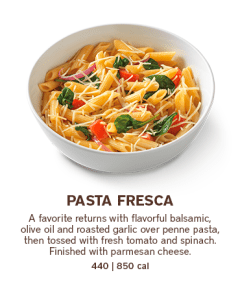
  • Small Pasta Fresca with shrimp spaghetti noodles from Noodles and Company
    • Add broccoli
    • Add mushrooms
  • Raspberry peach Mellow Yellow
  • Mango orange sparkling water

McDonald’s was another convenience food because I was late to my morning plans with my boyfriend and he once again decided he wasn’t going to feed me. There was nothing good to eat in my house that wouldn’t take a long time to make because my parents are health nuts and everything is awful and gluten-free.

I didn’t really eat lunch because I had to work at 3:00 and I didn’t get another chance to eat before then, so I made something small for myself to get me through the dinner rush.

For dinner I thought I would try my boyfriend’s favorite dish at Noodles. When I’m at work, I have easy access to sugary drinks, so I end up drinking them throughout my shift. So, it’s not uncommon for me to have a cup or two of soda. I try to break it up sometimes with a sparkling water because there are less calories.

Sunday:

Breakfast- None

Lunch-

  • Habenero’s chicken burrito
  • Venti white tea raspberry peach infusion lemonade from Starbucks
  • Two and a half Christmas cookies

Dinner-

  • Domino’s sausage and mushroom pizza (two and half pieces)
  • Cup of apple cider
  • Two more Christmas cookies

I got up at 11:00 so breakfast was long gone.

I was out running errands before going to a friend’s house, so I picked up a bomb ass burrito and some Starbucks. My friend’s grandma gave her family a plate of “Thanksgiving cookies” (even though they were Christmas colors) so naturally I had to eat a ton of them.

For dinner my friend’s parents ordered pizza so I had to eat a ton of that too. And more cookies.

Reflection:

What I’ve noticed from this food diary is that I eat like garbage and it’s starting to make me self-conscious about my body. I drink a ton of my calories because I have a bit of an addiction to sugary drinks and I don’t drink nearly enough water. I’m surprised I haven’t gained more weight than I have, and I think that’s because I only eat two meals a day but I’m still eating around 1700-2000 calories a day. My hope is that I can start working on this, so I can start to feel healthier and not so heavy all the time. Dining hall food is usually unappealing to me, so I end up eating junk. I’m going to try and make more conscience decisions about what I eat and drink less sugar and more water.


Pitch for Food Workers as Individual Agents of Culinary Globalization: Pizza and Pizzaioli in Japan by Rosella Ceccarini

The title of this article really doesn’t do it justice. It is very long and technical which distracts from the quality of this article.

Food Workers as Individual Agents of Culinary Globalization: Pizza and Pizzaioli gives a history of how pizza arrived in Japan during and after World War II and where the pizza scene stands today.

giulios4-600x450The author starts out by discussing how pizza is a very globalized food with many different cultures having their own take on pizza. From deep dish, to thin crust, to a calzone. However, the American pizza restaurants have “glocalized” pizza and turned the standard pizza into “a large sliced pizza, heavily garnished, baked in pans, and the taste is homogeneous, so a Domino’s pepperoni pizza ordered in Chicago should taste the same as one ordered in London or in Paris” (Ceccarini 438). But these are not the types of pizza the author is talking about in this article. While chain-restaurant pizzas are still very present in Japan, Ceccarini mainly focuses on authentic Italian pizza and their masters, the pizzaioli.
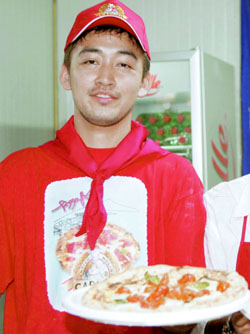
nn20060919f2aThough originally pizza started out as a poor person’s food in Italy, it has become popular throughout the world. Pizza in Japan really started to take off between the ’50s and ’60s and only increased in popularity from there throughout the ’70s and ’80s. Antonio Cancemi was on of the first people to open an authentic Italian restaurant in 1957 and his restaurant, Antonio’s, is still one of the oldest family owned restaurants in Japan. Making pizza has become recognized as an art form in Japan similarly as it has in Italy. There is a lot of cross over between Japan and Italy with many Italian people coming to Japan to open pizzerias, and many Japanese people to coming to Italy to learn how to become a pizzaiolo and then taking their skills back to Japan. Japanese people are very common to see in the pizza scene. Makoto Onishi (pictured above), a Japanese pizzaiolo, has one the Pizza Fest Competition in Naples, Italy, twice.
I think this article is worth a read because I found it to be quite interesting. While it isn’t extremely relevant to us in the United States, it still shows us the history and the culture behind pizza making outside of the chain-restaurant pizza we’ve come all-too familiar with. After reading this article I was left craving some real, authentic pizza which unfortunately isn’t as common as I would like it to be. But who knows? Maybe I just haven’t looked hard enough.

I think it would be an interesting class discussion topic to talk about how America has “ruined” these traditional dishes and Americanized ethnic cuisines. Many restaurants say they serve authentic food from wherever, but from what I’ve learned, most of the “authentic” food we’re eating is still completely different than what is and has been made in their native countries.

One negative aspect of this article is it did not define all of the non-English words that the author used so I had to look some of them up.

A Speech About Food Insecurity on College Campuses

Here is an outline I used for my speech composition class about food insecurity on college campuses. Not a super interesting read but informational nonetheless.

Food Insecurity on College Campuses

Specific Purpose Statement: To inform my audience about the prevalence of food insecurity on college campuses.

Central Idea: Food insecurity is very prevalent on college campuses and there are many resources offered to students to combat this issue, particularly at UW-Madison.

Introduction

  1. When most people think of someone who is experiencing food insecurity, the first thing they might think of is a homeless person, a single mother, or a child in Africa. Not many will think of a college student. In fact, the idea of a starving college student has become a running joke in our society. Few people actually realize how much of an issue it really has become.
  2. Since discussing this topic in my Food Culture class, I became interested in bringing awareness to the issue of food insecurity on college campuses and to what is being done about it, particularly at UW-Madison.
  • Through extensive research and discussion with experts in this subject, I have learned that when I look at my fellow students while walking to class, a great number of them might be wondering where their next meal is coming from.
  1. Today, I will be informing you about the prevalence of food insecurity on college campuses, who is affected and how they are affected by it, and finally the resources available to students on our campus so that you will know how you might be able to cope with your own food insecurity one day.

Transition: But before we get into any statistics, I should first answer the question:

Body

  1. “What is food insecurity?”
    • According to The U.S. Department of Agriculture (USDA), food insecurity can be defined as “a lack of consistent access to enough food for an active, healthy life.”
      • Furthermore, the USDA states that “characteristics of being food insecure can include reduced caloric intake, not having access to healthy food, lack of variety in diet, hunger without eating, and reduced weight due to not consuming enough calories.”
      • This means that someone who eats every day but does not eat nutrient-rich food, may still be food insecure. So, if you find that all you can afford to eat is ramen noodles and Cheeto puffs, you may be food insecure.

Transition: Now that we have established what food insecurity is, we can discuss its prevalence in the United States and its college campuses.

  1. Not having enough food to eat is a widespread problem in the United States.
    • Research has been done to figure out just how many people are affected by food insecurity.
      • According the 2017 USDA Report on Food Insecurity in the United States, 11.8% of households reported being food insecure.
      • In contrast, anthropologist Dr. Lisa Henry, in her article Understanding Food Insecurity Among College Students, states that food insecurity among college students is much higher than the national average with rates ranging from 14-59%.
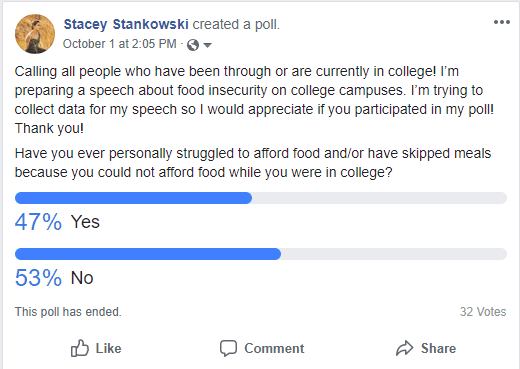
    • To do my own investigation into this issue, I created a Facebook poll.
      • I asked my friends, many of whom are college students, the question, “Have you ever personally struggled to afford food and/or have skipped meals because you could not afford food while you were in college?”
      • As you can see in this graph, the results support Dr. Henry’s research as out of the 32 people who responded to the poll, nearly 50% reported feeling food insecure while enrolled in secondary education.

2018-10-16 (1)


  • However, according to the UW-Madison 2016 climate survey, only 12%, or 1 in 8 students, reported they could not always afford sufficient food or housing.
  • While this is on the low end of the spectrum, it still means that out of the more than 40,000 students on this campus, nearly 5,500 of them struggle with being able to afford food.

Transition: Another really important question to ask is “Who are the students that are being affected by food insecurity?”

  1. Studies show that some students are more at risk of being food insecure than others.
    • Some of these students that are more at risk are minority students.
      • Dr. Henry writes that there was a large overrepresentation of African Americans who reported being food insecure in a study done at the University of North Texas (UNT).
    • Students receiving multiple forms of financial aid are more at risk.
      • Another study done by the American Journal of Health Promotion found that “the positive association between food insecurity and financial aid suggests that current financial aid might not be adequate to cover basic needs.”
    • And lastly, females are more at risk.
      • The study at UNT also showed a slight over-representation of females that are food insecure.
  2. Unfortunately, research has shown that food insecurity can have detrimental effects.
    • Students who are food insecure are less likely to be academically successful.
      • Maroto et al. found that food insecure students are more likely to report a low GPA rather than a high GPA.
      • Dr. Henry says “It is difficult for students to focus on school and synthesize classroom materials when they are hungry and worried about where they will get their next meal. Students need food to thrive, not just food to survive.”
    • This anxiety about not having enough food to eat can also take a toll on student’s mental health.
      • “College students who experience financial stress are more likely to suffer from anxiety, depression, and suicidal ideation,” Clare Cady notes in her article, Starving for Knowledge.

Transition: However, as awareness increases, universities are doing more to combat food insecurity.

  1. The amount of campus food pantries is increasing.
    • Dr. Henry’s research shows that “The College and University Food Bank Alliance (CUFBA) reports a growth from one campus food pantry in 2007 to 450 campus food pantries in early 2017.”
  2. UW-Madison has many resources available for students who struggle to get enough food. I’d like to share a few with you so that you might know where you can go if you find yourself not having enough to eat.
    • H. King is a student organization that focuses on offering free produce to students at UW-Madison.
      1. They hold Harvest Handouts that take place during the growing season at East Campus Mall at 2:00 on Fridays.
    • The Open Seat is the UW-Madison campus food pantry.
      • The Open Seat is a student run and student funded campus organization.
      • They offer perishable and non-perishable food items to students who have a WisCard.
      • In addition to food products, they also provide personal hygiene products.
  1. The Lutheran Campus Center also provides free meals.
    • Community meals take place Monday-Friday from 11:45-12:00 while school is in session.
  2. Lastly, Slow Food UW is a student organization that provides meals for free or at a low cost.
    • Family Dinner Night takes place on Mondays at The Crossing from 6:30-7:30 which includes a 3-course locally-sourced meal for only $3.
    • They also offer the Café Pay it Forward Program that uses donated money to provide a free lunch on Wednesdays from 11:30-1:30 at The Crossing.

Transition: All of these services are there so students can indeed “thrive, and not just survive.”

Conclusion

  1. In closing, food insecurity is not just the punchline of a joke, but a very real experience for many college students.
  2. I hope today I am leaving you with some more knowledge about an issue that often goes unspoken about and unnoticed on college campuses. I also hope that you are able to utilize some of these resources our campus offers if you find yourself worrying about where your next meal is going to come from.


Works Cited

Cady, Clare. “Starving for Knowledge: Why Campuses Need to Address Student Food       Insecurity.” About Campus, 2016, pp. 27–31.

Coleman-Jensen, Alisha, et al. “Household Food Security in the United States in 2017.” USDA ERS – Food Environment Atlas, Sept. 2018, http://www.ers.usda.gov/publications/pub-details/?pubid=90022.

United States Department of Agriculture. “Definitions of Food Security.” USDA ERS – Food  Environment Atlas, United States Department of Agriculture, 5 Sept. 2018,         http://www.ers.usda.gov/topics/food-nutrition-assistance/food-security-in-the-         us/definitions- of-food-security.aspx.

Henry, Lisa. “Understanding Food Insecurity Among College Students: Experience, Motivation, and Local Solutions.” ANNALS OF ANTHROPOLOGICAL PRACTICE, vol. 41, 2017, pp. 6–19.

Payne-Sturges, Devon C., et al. “Student Hunger on Campus: Food Insecurity Among College Students and Implications for Academic Institutions.” Student Hunger on Campus: Food Insecurity Among College Students and Implications for Academic Institutions, vol. 32, 2018, pp. 349–354.

The Student Food and Financial Security Coalition. Student Food and Financial Resource    GuideStudent Food and Financial Resource Guide, The Student Food and Financial Security Coalition, 2017.

University of Wisconsin-Madison. FOOD ASSISTANCE RESOURCE GUIDEFOOD ASSISTANCE RESOURCE GUIDE, University Health Services, 2016.

Feeding America. “What Is Food Insecurity in America?” Hunger and Health, Feeding America, 2018, hungerandhealth.feedingamerica.org/understand-food-insecurity/.


A Recipe by Stace

As I’ve previously said, when I cook, I don’t usually follow a recipe. If anything, I just use recipes for inspiration. Therefore, I also find it quite difficult to actually write down recipes for my concoctions because all my measurements are relative. I feel like an Italian grandmother in that sense. This will be the first time I have written any of my recipes down.

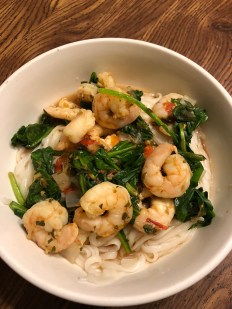
This recipe is something that I put together at some point when I was either in middle school or high school; I don’t remember exactly. It’s made of shrimp with garlic, lemon, spices, spinach, and tomatoes over rice noodles. I think I’ll call it:

Lemon Garlic Shrimp and Veggies Over Rice Noodles

Since that just rolls right off the tongue.

This dish has been a staple in my house since my family members seem to enjoy it. My has mom regularly asked me to make my “shrimp dish” while referring to this one, even though I make several different types of “shrimp dishes.” I guess it’s sort of an Italian stir fry, which gives me an excuse to use my wok.

The reason I use rice noodles is because both of my parent are gluten free hipsters. They have several of these “food sensitivities” and recently my dad has sworn off garlic and butter, much to my dismay. I don’t cook for them much anymore because of this and I guess it’s not really their fault that they feel better after they’ve cut foods out of their diets, but it does come at a cost–flavor. Cooking shrimp without garlic is like making salsa without tomatoes. I must admit, I actually do really like it with the rice noodles because they soak up more sauce than regular spaghetti noodles.

This evening though, my mother tried to recreate my dish and it wasn’t as bad as I thought it was going to be. I was severely missing the garlic though. Nonetheless, I became inspired to do a recipe blog post. Also because I had easy access to visual content.file

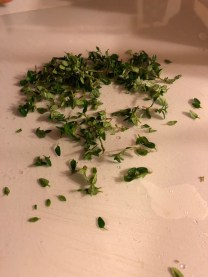
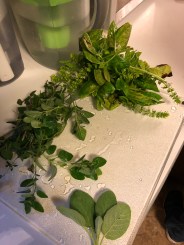
It’s harvest season so I had a bunch of herbs from my mom’s garden to include in this recipe. Fresh herbs are the best way to spice up your dish and make it more flavorful and refreshing.

Ladies, gentlemen, and non-binary people, I present the secret recipe that up until today, has only existed in my mind:

(These are all approximations)

file8

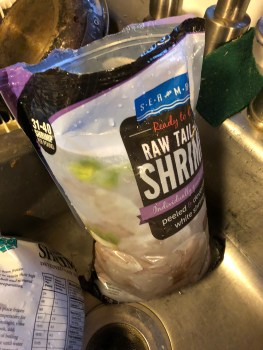
  • About 1lb of Raw, peeled and deveined shrimp
  • 3 cloves of fresh garlic
  • 1/4 of a white onion
  • 1 lemon
  • 2 Tbsp of butter
  • 1/4 of half and half (optional)
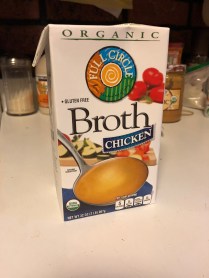
  • 1 cup of chicken broth
  • 1 Tbsp of fresh basil
  • 2 tomatoes or one package of cherry tomatoes, diced (or sliced in half)
  • 4 cups of spinach
  • 1 tsp of fresh oregano
  • 1/2 tsp of fresh thyme
  • 1 small fresh sage leaf
  • Dash of red pepper flakes
  • Salt and pepper to taste
  • 1 package of rice noodles
  • Bragg Liquid Aminos (Optional)

file4

The first thing I do when prepping this dish is thaw my shrimp. It’s incredibly important to cook with raw shrimp rather than pre-cooked shrimp. This will help prevent the shrimp from becoming overcooked and getting that tough chewy texture that is not so pleasant. You want your shrimp to melt in you mouth. Here we used shrimp that was already peeled and deveined which is much less of a hassle to deal with than tail-on shrimp. My mom opted to thaw the shrimp by filling the bag with hot water. I usually put all the shrimp I’m going to use in a separate pot with a lid and then filling it with warm water but either way works well. I let it sit for about 5-10 minutes and the shrimp will usually be thawed. Shrimp thaws very quickly and requires little to no preparation beforehand.

Next, put a pot filled 3/4 of the way up with water on the stove for the noodles and turn it on high. I don’t typically salt the water when I cook rice noodles but you can if it tickles your fancy. Put a lid over it; this helps the water boil faster.

Go ahead and chop that onion now.

I have a wok laying around my house and I generally use it for this dish. It just feels right. For those of you who don’t know, this is a wok:

woks-zwilling-henckels-sensation-wok-30cm-1_1024x1024

It’s just a big ass bowl pan, you feel?

If you don’t have a wok, that’s totally fine. You can just use a regular large frying pan.file1

Heat said pan over low to medium heat. While the pan is still heating up, I usually use this time to chop 2-3 cloves of garlic, depending on the size. I have a Ninja food processor that I use to chop my garlic because A) I hate getting garlic juice on my fingers because it sticks around for DAYS, and B) because I’m lazy. I find the Ninja works quite well and gets the garlic to be a small uniform size. After you’ve chopped/processed your garlic, proceed to chop/process your herbs as well. Divide the herbs in half and set some aside.

When the pan has reached the right temperature, put in the butter or the olive oil (the healthier but less tasty option) in the pan. If the butter starts aggressively sizzling, take the pan off of the heat element so the butter won’t burn and be gross. Add the garlic and the chopped onions and saute for 2-3 minutes or until onions start to become transparent.

Add the broth to the pan and bring to a simmer. Then add the half and half if you desire. This just makes the dish a little bit creamy. Totally not necessary though. I only do this occasionally. Today, I did not.file2

Next add the juice of half a lemon. Save the other half to add more to taste later.

Season the broth with half of the herbs and salt and pepper. I do this because I think it helps the shrimp soak up more flavor as it cooks. Taste the broth to make sure it’s not disgusting.

Now would be a good time to add the shrimp.

Cook the shrimp until they fully turn pink and the tails begin to curl slightly. 7-ish minutes? Taste it. The shrimp should be very tender and easily chew-able. If the texture is tough, you have overcooked them which is quite a shame but not the end of the world. After tasting the shrimp, adjust your seasonings accordingly. Add more lemon, basil, oregano, thyme, salt, pepper, if needed. I like my shrimp to have a strong basil flavor. Remove the pan from the heating element so the shrimp doesn’t keep cooking.file6

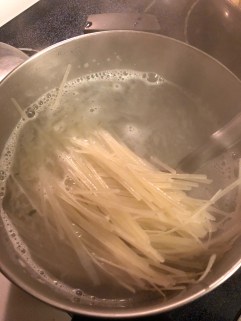
At this point, your noodle water should be boiling. Turn your pot down to medium heat and add the rice noodles. Turning your heat down should help to prevent the water from boiling over. Your water should still maintain a rolling boil. If the water stops boiling, put a cover over the pot to keep the pot from losing heat and turn the heat up only slightly. TBH, I haven’t totally mastered the art of keeping my water from boiling over and I can’t say that any of these techniques actually work but they’re definitely worth a shot. Stir the noodles and cook them until they are just past al dente. Drain the water from the noodles when they are ready and run them under water to remove the grainy residue that rice noodles always seem to get.file3

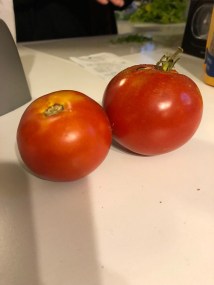
I’m horrible at planning, so this is the time when I would probably chop my tomatoes. My mom had fresh ones from her garden that were starting to get old. The best way to use old tomatoes is to cook them. This way they lose the really acidic taste they have when they’re uncooked.

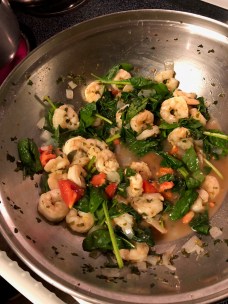
Add the tomatoes and the spinach to the shrimp and return the pan to the element over low heat. Cover the pan. You want to only cook the tomatoes and the spinach so that they wilt slightly and the skin on the tomatoes get wrinkly and start to separate from the flesh.

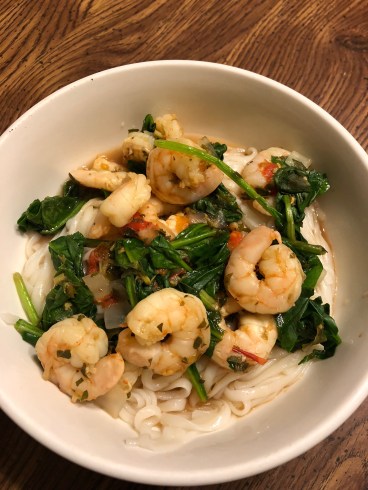
Guess what? Your food is done.file7

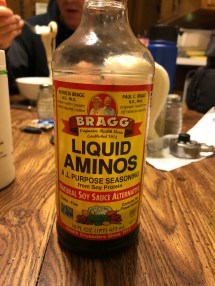
Serve the shrimp and veggies over the rice noodles. You can leave it just like that and eat it. Or, for an added touch, I like to pour a little bit of Bragg Liquid Aminos over the shrimp. Liquid Aminos has a very particular salty flavor that is kind of hard to describe, but I have always used it growing up as a substitute for soy sauce, even though it tastes nothing like it. Just a family quirk I think.

Enjoy!

file5

file8

A Review of Rising Sons Deli

Image-5Today, Friday, September 21, 2018, I visited Rising Sons Deli, a Thai food restaurant on State Street. I was feeling pretty down in the dumps today. So, I figured the best way to self-medicate would be to get some of my favorite cuisine and write a restaurant review. I was a little confused when I first walked in because there wasn’t a hostess so I kind of wandered awkwardly around the bar until a man asked me if I wanted to eat for here or to go. The atmosphere was nice and there weren’t very many people. I don’t think there was any music playing which is uncommon for a restaurant. Maybe that’s why I felt so awkward. It smelled fantastic though. I did notice that a lot of tables had dishes on them still, though they weren’t that busy, however, I know how this goes in my experience. They seemed to be short staffed.

Pictures of all the major menu items were on a banner on the wall which sort gave of a cheap Chinese food place vibe, but I was still willing to give it a shot because they did have regular menus also. I did notice that their menu said that they don’t accept credit cards which was disappointing, but luckily, I had enough cash. I took a seat outside in their “Ally Cat Seating” which was unlike anywhere I’ve been seated before. I kind of felt like I wasn’t in Madison anymore with the traditional plant pots and wooden floor that were situated between brick walls. I was able to see the sky as I ate which was quite pleasant. It felt like I was inside and outside at the same time. The only downside is that twigs and leaves would fall into my food when the wind blew. A man with a South African accent sat with a woman two tables away from me. I was only bothered by the loud exclamation of an inebriated sounding man on the street. It was only 1:10 in the afternoon which was way too early to be drunk, but I digress.

When the man came to take my order, he was kind enough to tell me that I should move my phone to the outside of the table because many people have bumped their phones off the edge and have fallen down a gap in the floor to never have been seen again.

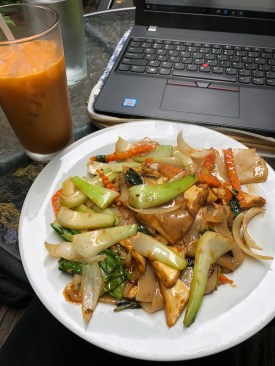
Unfortunately, they did not have my favorite dish, Pad Wun Sen, but they had Pad Kee Mao (Drunken Noodles) though, which I am also a fan of. I ordered it with tofu which cost me $9.95. I also ordered a Thai iced tea ($3.00) because I believe a Thai food restaurant is only as good as their iced tea. The man brought out my tea very quickly and it didn’t have too much ice in it. It was served in the traditional fashion with the tea on bottom and the cream on top, so you have to stir it to enjoy it. I really liked the iced tea. It was perhaps a little bit on the sweet side, but it had a good cream to tea ratio and the tea wasn’t super strong like it is at some Thai food restaurants where there is a very bitter after taste. I’d give the tea a 4.5/5 rating.

The man brought out my Drunken Noodles in about 5-7 minutes, which was not much of a wait at all. The food was piping hot and looked delicious. I could hardly wait to start shoveling it in my mouth, and therefore burned my tongue. Drunken Noodles is a sort of spicy and sour wide noodle dish with basil. This one also had egg, carrots, bok choy, and onion. It was well sauced and well salted (I’m picky about my salt. I have low blood pressure, so everything needs to have at least a teaspoon). The plentiful basil leaves were left whole which I enjoyed because I like having a lot of basil flavor in each forkful. It wasn’t too spicy like they’ve been at other restaurants where I could hardly eat them and had to send them back because they were just too damn spicy. I don’t think I’m a wuss about those types of things either. There was a good amount of food on the plate and I was left feeling satisfied after I finished. The one thing that I was missing was some broccoli and that’s just because I stan vegetables. I’d give this dish a 4.5/5 as well.

No one came to check up on me during my meal, which I didn’t really mind. I don’t like to be bothered and I didn’t really want them to see that I was writing a restaurant review. However, I do think that some people would have liked a little more attentiveness. I went up to the bar and paid at a register instead of receiving a check. I didn’t mind this either, it was just less formal than other sit-down restaurants. I offered to bring my dishes to the front since I wanted to do my due diligence because I am also a food service worker (ALWAYS offer to take your own dishes in restaurants like this!), but the woman at the register said it was fine for me to leave them.

Overall, I very much enjoyed this restaurant and I can definitely see myself frequenting Rising Sons Deli if I want to study in a chill environment and not be bothered. I’m happy that I found a good Thai food restaurant on campus that I like. I think I might bring my boyfriend, Chandler, here sometime or grab a lunch date. However, I was still very content just eating here by myself. Just wish they had Wi-Fi. 9/10 would recommend.