
The title of this article really doesn’t do it justice. It is very long and technical which distracts from the quality of this article.
Food Workers as Individual Agents of Culinary Globalization: Pizza and Pizzaioli gives a history of how pizza arrived in Japan during and after World War II and where the pizza scene stands today.
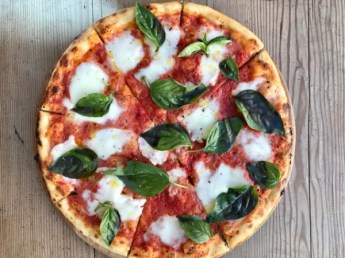 The author starts out by discussing how pizza is a very globalized food with many different cultures having their own take on pizza. From deep dish, to thin crust, to a calzone. However, the American pizza restaurants have “glocalized” pizza and turned the standard pizza into “a large sliced pizza, heavily garnished, baked in pans, and the taste is homogeneous, so a Domino’s pepperoni pizza ordered in Chicago should taste the same as one ordered in London or in Paris” (Ceccarini 438). But these are not the types of pizza the author is talking about in this article. While chain-restaurant pizzas are still very present in Japan, Ceccarini mainly focuses on authentic Italian pizza and their masters, the pizzaioli.
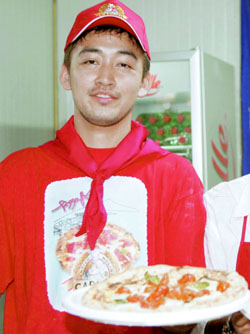 Though originally pizza started out as a poor person’s food in Italy, it has become popular throughout the world. Pizza in Japan really started to take off between the ’50s and ’60s and only increased in popularity from there throughout the ’70s and ’80s. Antonio Cancemi was on of the first people to open an authentic Italian restaurant in 1957 and his restaurant, Antonio’s, is still one of the oldest family owned restaurants in Japan. Making pizza has become recognized as an art form in Japan similarly as it has in Italy. There is a lot of cross over between Japan and Italy with many Italian people coming to Japan to open pizzerias, and many Japanese people to coming to Italy to learn how to become a pizzaiolo and then taking their skills back to Japan. Japanese people are very common to see in the pizza scene. Makoto Onishi (pictured above), a Japanese pizzaiolo, has one the Pizza Fest Competition in Naples, Italy, twice.
I think this article is worth a read because I found it to be quite interesting. While it isn’t extremely relevant to us in the United States, it still shows us the history and the culture behind pizza making outside of the chain-restaurant pizza we’ve come all-too familiar with. After reading this article I was left craving some real, authentic pizza which unfortunately isn’t as common as I would like it to be. But who knows? Maybe I just haven’t looked hard enough.
I think it would be an interesting class discussion topic to talk about how America has “ruined” these traditional dishes and Americanized ethnic cuisines. Many restaurants say they serve authentic food from wherever, but from what I’ve learned, most of the “authentic” food we’re eating is still completely different than what is and has been made in their native countries.
One negative aspect of this article is it did not define all of the non-English words that the author used so I had to look some of them up.

 Stace's Food Blog