Here is an outline I used for my speech composition class about food insecurity on college campuses. Not a super interesting read but informational nonetheless.
Food Insecurity on College Campuses
Specific Purpose Statement: To inform my audience about the prevalence of food insecurity on college campuses.
Central Idea: Food insecurity is very prevalent on college campuses and there are many resources offered to students to combat this issue, particularly at UW-Madison.
Introduction
- When most people think of someone who is experiencing food insecurity, the first thing they might think of is a homeless person, a single mother, or a child in Africa. Not many will think of a college student. In fact, the idea of a starving college student has become a running joke in our society. Few people actually realize how much of an issue it really has become.
- Since discussing this topic in my Food Culture class, I became interested in bringing awareness to the issue of food insecurity on college campuses and to what is being done about it, particularly at UW-Madison.
- Through extensive research and discussion with experts in this subject, I have learned that when I look at my fellow students while walking to class, a great number of them might be wondering where their next meal is coming from.
- Today, I will be informing you about the prevalence of food insecurity on college campuses, who is affected and how they are affected by it, and finally the resources available to students on our campus so that you will know how you might be able to cope with your own food insecurity one day.
Transition: But before we get into any statistics, I should first answer the question:
Body
- “What is food insecurity?”
- According to The U.S. Department of Agriculture (USDA), food insecurity can be defined as “a lack of consistent access to enough food for an active, healthy life.”
- Furthermore, the USDA states that “characteristics of being food insecure can include reduced caloric intake, not having access to healthy food, lack of variety in diet, hunger without eating, and reduced weight due to not consuming enough calories.”
- This means that someone who eats every day but does not eat nutrient-rich food, may still be food insecure. So, if you find that all you can afford to eat is ramen noodles and Cheeto puffs, you may be food insecure.
- According to The U.S. Department of Agriculture (USDA), food insecurity can be defined as “a lack of consistent access to enough food for an active, healthy life.”
Transition: Now that we have established what food insecurity is, we can discuss its prevalence in the United States and its college campuses.
- Not having enough food to eat is a widespread problem in the United States.
- Research has been done to figure out just how many people are affected by food insecurity.
- According the 2017 USDA Report on Food Insecurity in the United States, 11.8% of households reported being food insecure.
- In contrast, anthropologist Dr. Lisa Henry, in her article Understanding Food Insecurity Among College Students, states that food insecurity among college students is much higher than the national average with rates ranging from 14-59%.
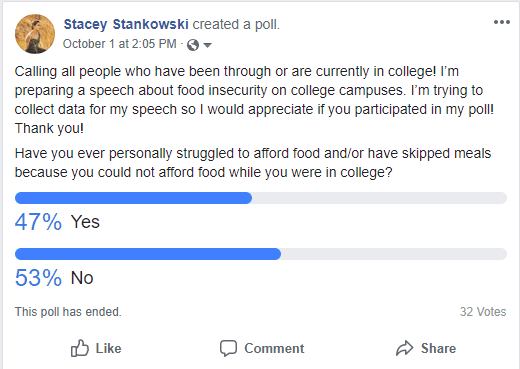
- To do my own investigation into this issue, I created a Facebook poll.
- I asked my friends, many of whom are college students, the question, “Have you ever personally struggled to afford food and/or have skipped meals because you could not afford food while you were in college?”
- As you can see in this graph, the results support Dr. Henry’s research as out of the 32 people who responded to the poll, nearly 50% reported feeling food insecure while enrolled in secondary education.
- Research has been done to figure out just how many people are affected by food insecurity.
- However, according to the UW-Madison 2016 climate survey, only 12%, or 1 in 8 students, reported they could not always afford sufficient food or housing.
- While this is on the low end of the spectrum, it still means that out of the more than 40,000 students on this campus, nearly 5,500 of them struggle with being able to afford food.
Transition: Another really important question to ask is “Who are the students that are being affected by food insecurity?”
- Studies show that some students are more at risk of being food insecure than others.
- Some of these students that are more at risk are minority students.
- Dr. Henry writes that there was a large overrepresentation of African Americans who reported being food insecure in a study done at the University of North Texas (UNT).
- Students receiving multiple forms of financial aid are more at risk.
- Another study done by the American Journal of Health Promotion found that “the positive association between food insecurity and financial aid suggests that current financial aid might not be adequate to cover basic needs.”
- And lastly, females are more at risk.
- The study at UNT also showed a slight over-representation of females that are food insecure.
- Some of these students that are more at risk are minority students.
- Unfortunately, research has shown that food insecurity can have detrimental effects.
- Students who are food insecure are less likely to be academically successful.
- Maroto et al. found that food insecure students are more likely to report a low GPA rather than a high GPA.
- Dr. Henry says “It is difficult for students to focus on school and synthesize classroom materials when they are hungry and worried about where they will get their next meal. Students need food to thrive, not just food to survive.”
- This anxiety about not having enough food to eat can also take a toll on student’s mental health.
- “College students who experience financial stress are more likely to suffer from anxiety, depression, and suicidal ideation,” Clare Cady notes in her article, Starving for Knowledge.
- Students who are food insecure are less likely to be academically successful.
Transition: However, as awareness increases, universities are doing more to combat food insecurity.
- The amount of campus food pantries is increasing.
- Dr. Henry’s research shows that “The College and University Food Bank Alliance (CUFBA) reports a growth from one campus food pantry in 2007 to 450 campus food pantries in early 2017.”
- UW-Madison has many resources available for students who struggle to get enough food. I’d like to share a few with you so that you might know where you can go if you find yourself not having enough to eat.
- H. King is a student organization that focuses on offering free produce to students at UW-Madison.
- They hold Harvest Handouts that take place during the growing season at East Campus Mall at 2:00 on Fridays.
- The Open Seat is the UW-Madison campus food pantry.
- The Open Seat is a student run and student funded campus organization.
- They offer perishable and non-perishable food items to students who have a WisCard.
- In addition to food products, they also provide personal hygiene products.
- H. King is a student organization that focuses on offering free produce to students at UW-Madison.
- The Lutheran Campus Center also provides free meals.
- Community meals take place Monday-Friday from 11:45-12:00 while school is in session.
- Lastly, Slow Food UW is a student organization that provides meals for free or at a low cost.
- Family Dinner Night takes place on Mondays at The Crossing from 6:30-7:30 which includes a 3-course locally-sourced meal for only $3.
- They also offer the Café Pay it Forward Program that uses donated money to provide a free lunch on Wednesdays from 11:30-1:30 at The Crossing.
Transition: All of these services are there so students can indeed “thrive, and not just survive.”
Conclusion
- In closing, food insecurity is not just the punchline of a joke, but a very real experience for many college students.
- I hope today I am leaving you with some more knowledge about an issue that often goes unspoken about and unnoticed on college campuses. I also hope that you are able to utilize some of these resources our campus offers if you find yourself worrying about where your next meal is going to come from.
Works Cited
Cady, Clare. “Starving for Knowledge: Why Campuses Need to Address Student Food Insecurity.” About Campus, 2016, pp. 27–31.
Coleman-Jensen, Alisha, et al. “Household Food Security in the United States in 2017.” USDA ERS – Food Environment Atlas, Sept. 2018, http://www.ers.usda.gov/publications/pub-details/?pubid=90022.
United States Department of Agriculture. “Definitions of Food Security.” USDA ERS – Food Environment Atlas, United States Department of Agriculture, 5 Sept. 2018, http://www.ers.usda.gov/topics/food-nutrition-assistance/food-security-in-the- us/definitions- of-food-security.aspx.
Henry, Lisa. “Understanding Food Insecurity Among College Students: Experience, Motivation, and Local Solutions.” ANNALS OF ANTHROPOLOGICAL PRACTICE, vol. 41, 2017, pp. 6–19.
Payne-Sturges, Devon C., et al. “Student Hunger on Campus: Food Insecurity Among College Students and Implications for Academic Institutions.” Student Hunger on Campus: Food Insecurity Among College Students and Implications for Academic Institutions, vol. 32, 2018, pp. 349–354.
The Student Food and Financial Security Coalition. Student Food and Financial Resource Guide. Student Food and Financial Resource Guide, The Student Food and Financial Security Coalition, 2017.
University of Wisconsin-Madison. FOOD ASSISTANCE RESOURCE GUIDE. FOOD ASSISTANCE RESOURCE GUIDE, University Health Services, 2016.
Feeding America. “What Is Food Insecurity in America?” Hunger and Health, Feeding America, 2018, hungerandhealth.feedingamerica.org/understand-food-insecurity/.

 Stace's Food Blog